Singh Song!
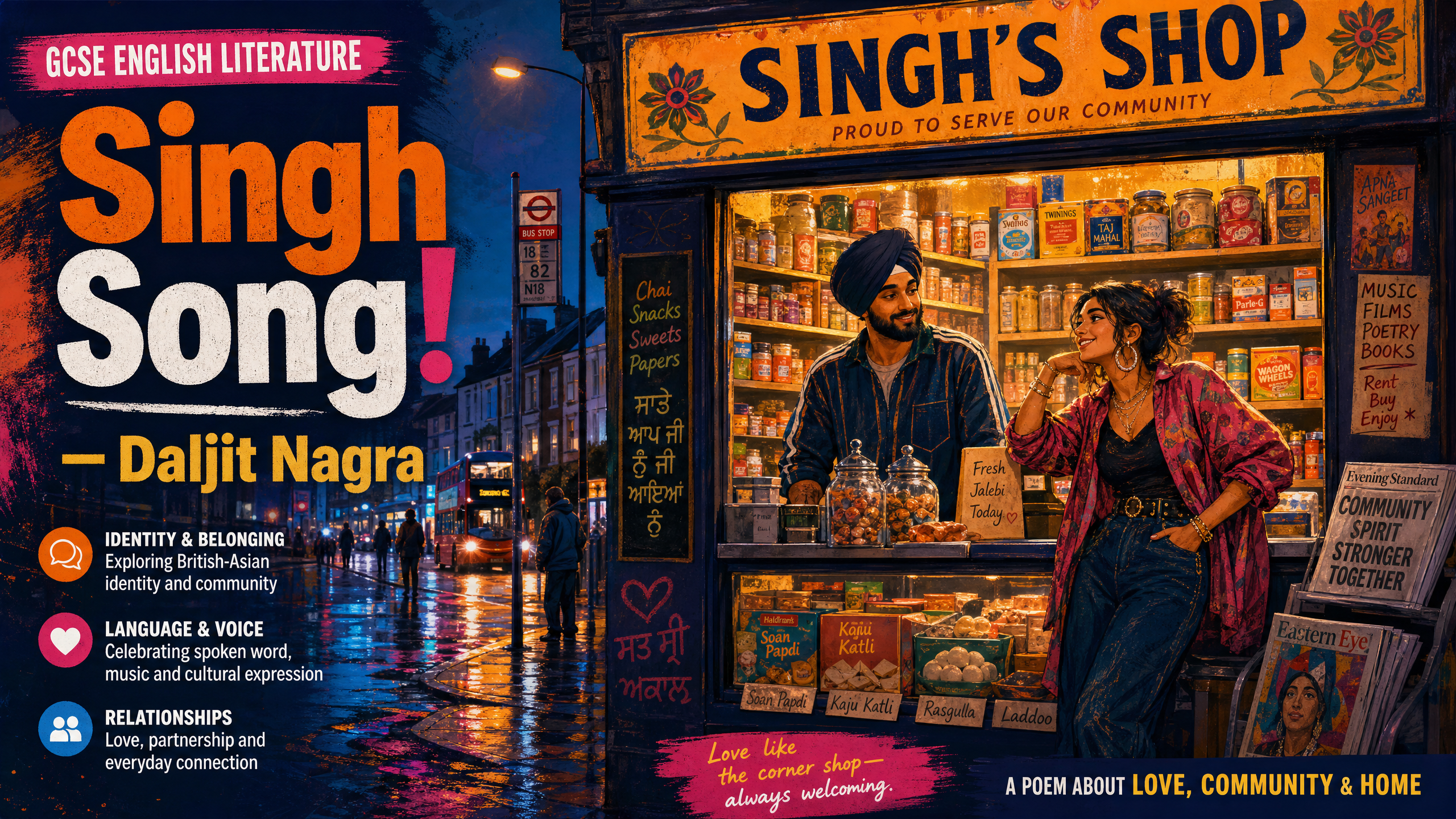
Daljit Nagra’s 'Singh Song!' is a vibrant, joyful, and culturally rich love poem that celebrates a newlywed British-Indian couple navigating life in a corner shop. It is a brilliant text to study because it subverts traditional romantic tropes with humour and code-switching, offering rich opportunities for candidates to analyse language, structure, and the complex theme of diaspora identity.
Study Notes
Overview
Daljit Nagra’s 'Singh Song!' is a joyful, energetic poem from the AQA 'Love and Relationships' anthology. Narrated by a newlywed British-Indian shopkeeper, the poem explores his passionate relationship with his modern, rebellious wife, set against the backdrop of their busy corner shop. For examiners, this poem is a goldmine. It allows candidates to demonstrate AO2 (analysis of writer's methods) by exploring Nagra's use of phonetic dialect, irregular free verse, and the song-like refrain. Furthermore, it offers excellent opportunities for AO3 (context) by addressing the British-Indian diaspora, cultural hybridity, and the subversion of both traditional love poetry and immigrant stereotypes.
Listen to our comprehensive revision podcast for an in-depth audio guide:
Plot/Content Overview
The poem follows a young Sikh man who has recently taken over his father's corner shop. However, instead of focusing on the business, he is entirely distracted by his new wife. He frequently abandons the shop floor to spend time with her upstairs, much to the frustration of his customers. The poem details his wife's modern, slightly rebellious behaviour (running a dating agency, wearing a tartan sari, swearing at his mother). In the final stanzas, the chaotic energy of the shop fades as the couple sit together late at night, looking out at the moon, sharing a moment of quiet, tender intimacy.
Themes
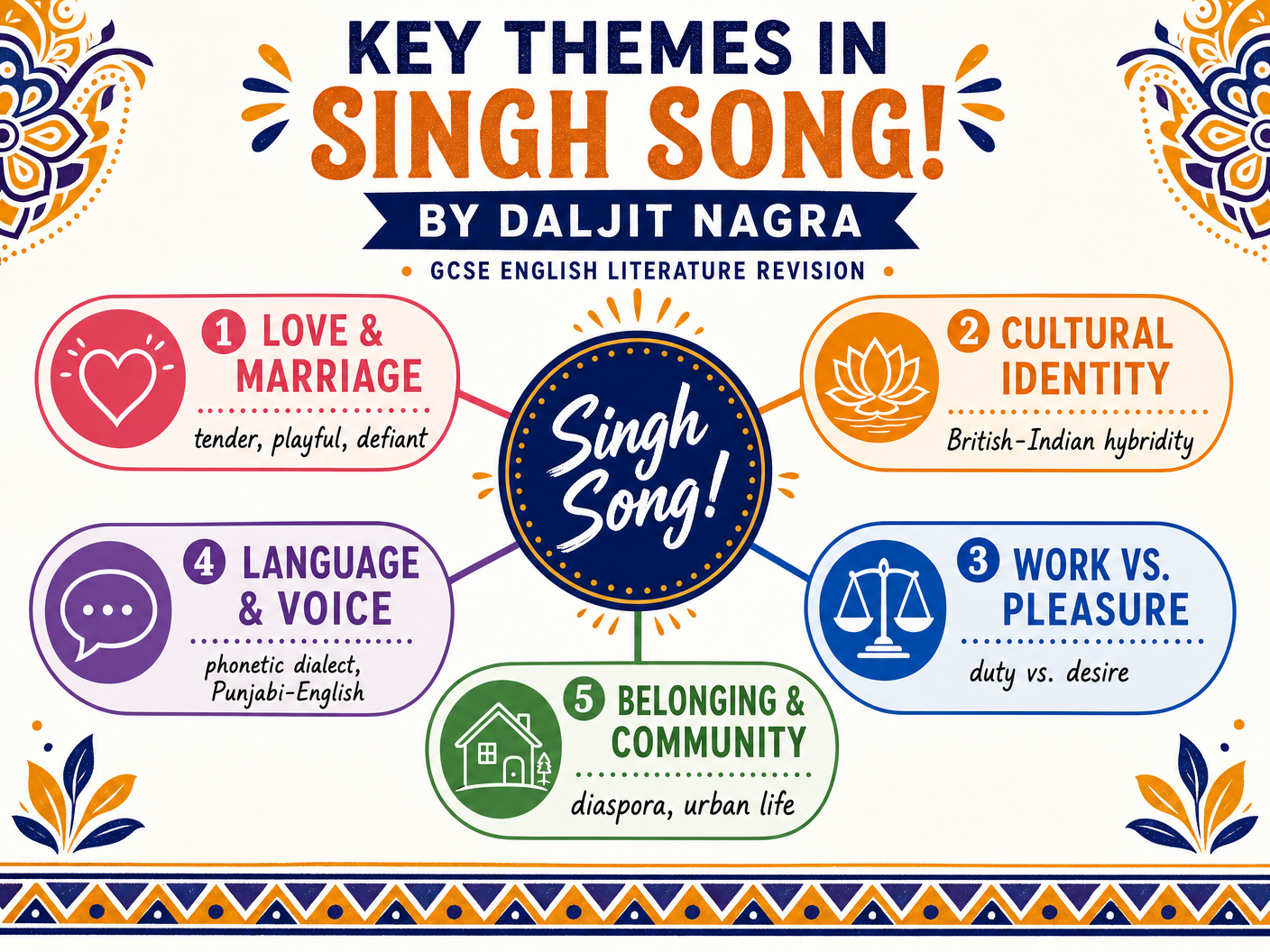
Theme 1: Love, Devotion and Marriage
The poem is, fundamentally, a celebration of romantic love. Unlike many poems in the anthology that focus on loss or unrequited love, 'Singh Song!' portrays a relationship that is passionate, joyful, and deeply affectionate. The speaker is utterly devoted to his wife, prioritizing her over his family duties and business responsibilities.
Key Quotes:
- "my bride" (Repeated refrain) - The possessive pronoun "my" and the word "bride" emphasize his pride, devotion, and the freshness of their marriage. The repetition creates a heartbeat-like rhythm of affection.
- "from di stool each night she say, / How much do yoo charge for dat moon baby?" (Stanza 12) - This playful exchange highlights their intimacy. The shift to nighttime brings a quieter, more tender tone, contrasting with the chaotic daytime shop.
Theme 2: Cultural Identity and Hybridity
Nagra explores the experience of the British-Indian diaspora, celebrating a "third space" where cultures blend. The poem challenges monolithic stereotypes of South Asian immigrants, presenting a modern couple who navigate both their heritage and their British environment.
Key Quotes:
- "she wear a Tartan sari" (Stanza 8) - A striking visual image of cultural hybridity. Tartan (Scottish) and sari (South Asian) are fused together, representing the couple's blended British-Asian identity.
- "she hav a red crew cut / and she wear a Tartan sari" (Stanza 8) - The wife subverts traditional expectations of a demure, submissive Indian bride. She is bold, modern, and unapologetically herself.
Theme 3: Duty vs. Desire (Work vs. Pleasure)
The poem creates a comic tension between the speaker's responsibilities (running the shop, fulfilling his father's expectations) and his personal desires (spending time with his wife).
Key Quotes:
- "I run just one ov my daddy's shops / from 9 o'clock to 9 o'clock" (Stanza 1) - Highlights the intense work ethic often associated with immigrant families. The repetition of "9 o'clock" emphasizes the long, monotonous hours.
- "Hey Singh, ver yoo bin? / Yor lemons are limes / yor bananas are plantain" (Stanza 5) - The complaints of the customers provide a comic chorus. The speaker's neglect of the shop physically manifests in the rotting/confused fruit, symbolizing his rejection of capitalist duty in favour of romantic pleasure.
Character Analysis
The Speaker (The Shopkeeper)
Role: The narrator and protagonist, navigating his new roles as husband and businessman.
Key Traits: Devoted, joyful, rebellious (in a mild way), culturally grounded.
Character Arc: He moves from the chaotic, frantic energy of juggling the shop and his wife during the day, to a state of peaceful, contented intimacy with her at night.
Essential Quotes:
- "I do di lock" (Stanza 3) - Shows his active choice to shut out the world and prioritize his wife.
- "is priceless baby" (Final line) - Concludes the poem by elevating their love above the commercial world of the shop.
The Wife ("My Bride")
Role: The object of the speaker's affection and a symbol of modern British-Asian womanhood.
Key Traits: Independent, bold, modern, playful, culturally hybrid.
Essential Quotes:
- "she effing at my mum" (Stanza 7) - Shows her rebellious nature and refusal to conform to traditional subservient daughter-in-law roles.
- "she hav a red crew cut" (Stanza 8) - A visual rejection of traditional femininity.
Writer's Methods
Language and Voice
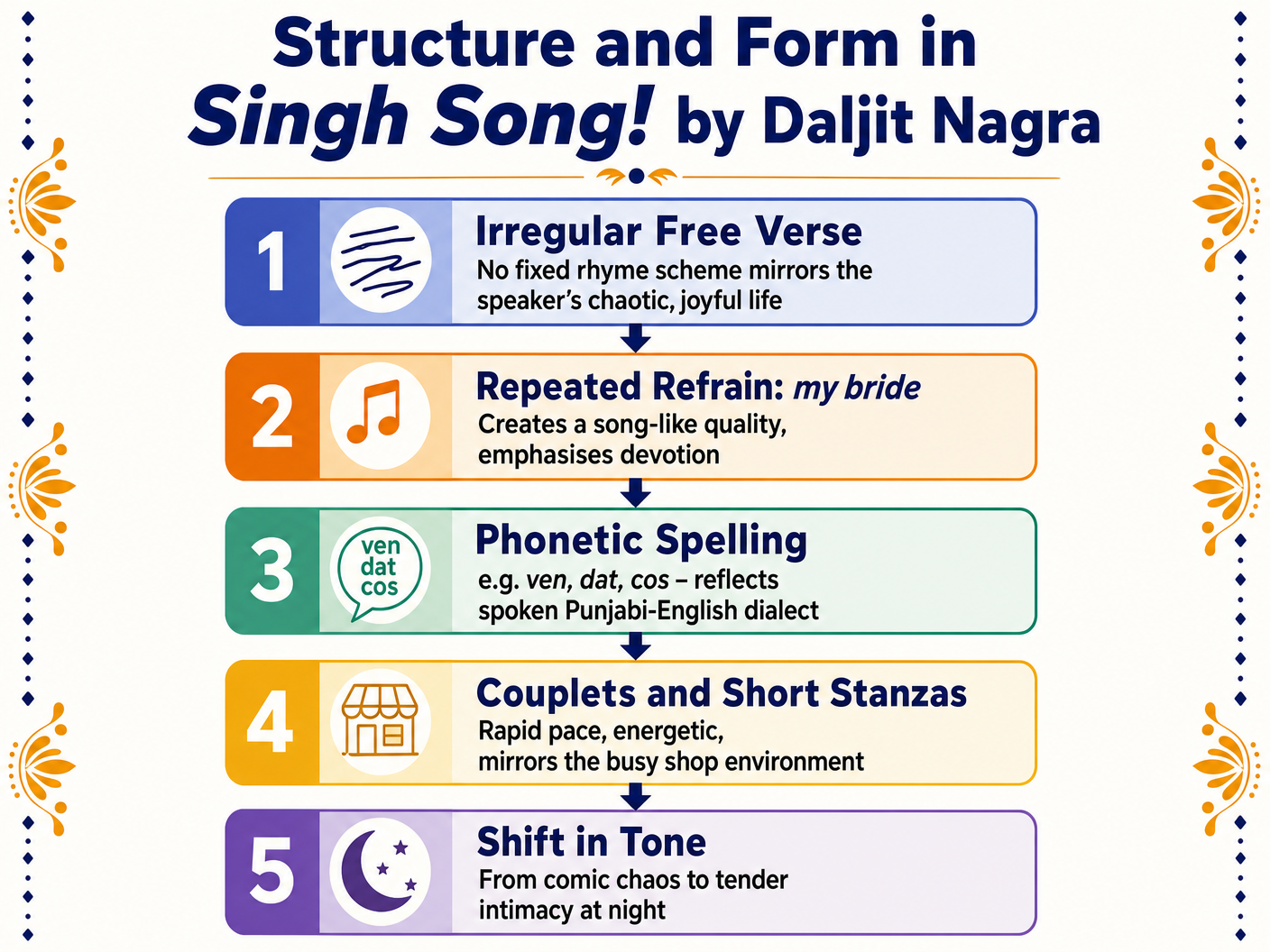
Nagra's most distinctive method is his use of phonetic spelling to represent a Punjabi-inflected English dialect (e.g., "ven", "dat", "di"). This code-switching authenticates the speaker's voice, celebrates the diversity of British English, and challenges the dominance of Standard English in literature. It forces the reader to "hear" the poem in the speaker's specific accent.
Form and Structure
The poem is written in free verse with highly irregular stanza lengths. This lack of rigid structure mirrors the chaotic, unpredictable, and joyful nature of the speaker's life.
However, there are key structural patterns:
- The Refrain: The repetition of "my bride" acts as a musical chorus, grounding the poem in the speaker's devotion.
- The Chorus of Customers: The italicized complaints of the "shoppers" provide a rhythmic interruption, contrasting the mundane world of commerce with the speaker's romantic obsession.
- Tonal Shift: The poem moves from the frantic, comic energy of the daytime stanzas to the slow, tender, lyrical couplets at the end ("from di stool each night..."). The pace slows down, reflecting the quiet intimacy of the couple alone.
Context
Daljit Nagra is a British poet of Sikh Punjabi descent. His work frequently explores the experiences of Indians born in the UK (often termed British Asians).
Examiners expect candidates to understand that this poem is part of a broader literary movement that gives voice to marginalized communities. The poem plays with, and subverts, the stereotype of the hardworking Asian shopkeeper (the "corner shop" trope). Instead of a narrative about hardship or racism, Nagra offers a joyful celebration of love and cultural fusion. The wife's "Tartan sari" perfectly encapsulates this "third space" of identity—neither fully traditional Indian nor fully traditional British, but a vibrant new synthesis.
Visual Resources
2 diagrams and illustrations
Interactive Diagrams
1 interactive diagram to visualise key concepts
Conceptual Flow Outline
The narrative and emotional arc of Singh Song!
Worked Examples
2 detailed examples with solutions and examiner commentary
Practice Questions
Test your understanding — click to reveal model answers
Compare how poets present the effects of love in 'Singh Song!' and one other poem from the 'Love and Relationships' anthology.
Hint: Consider 'Sonnet 29' for a comparison of obsessive, joyful love, or 'The Farmer's Bride' for a contrast in how marriage is experienced.
How does Daljit Nagra use language and structure to create a distinctive voice in 'Singh Song!'?
Hint: Focus heavily on AO2. Discuss phonetic spelling, the refrain, and the shift in stanza length.
Explore how Nagra presents ideas about cultural identity in 'Singh Song!'.
Hint: Look at the wife's clothing, the blending of languages, and the setting of the corner shop.
Compare how poets present defiance or rebellion in 'Singh Song!' and one other poem.
Hint: Think about how the speaker defies his father's expectations, and how the wife defies traditional gender roles. 'Porphyria's Lover' could provide a dark contrast to defiance.